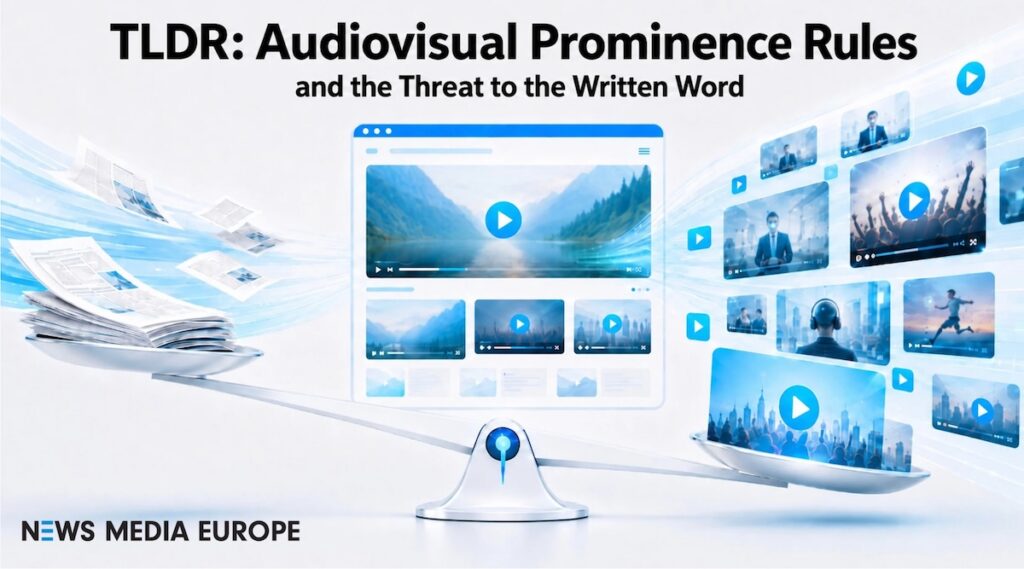










The EU’s audiovisual rulebook is coming under review and the European Commission is considering changes to its prominence rules for audiovisual content, and whether those rules should extend to new distribution channels for audiovisual offerings.
Yet, this raises critical questions of public interest as most distribution platforms host content across multiple formats, think of app stores, social networks, search engines and news aggregators that carry text and video side by side. On those platforms, prominence rules will inevitably promote video content at the expense of other types of content. And so, the EU could discourage reading on the platforms where most people now read, at a time when literacy skills across Europe are in sharp decline.
Article 7a of the Audiovisual Media Services Directive states that Member States may take measures to ensure the prominence of audiovisual services of general interest and impose such obligations where they are necessary to meet general interest objectives, such as media pluralism, freedom of speech and cultural diversity.
These rules were born in an era of limited broadcasting capacity and tightly controlled physical distribution networks. Guaranteeing space for broadcasters serving the general interest made sense, when the availability of slots was the main constraint.
That world no longer exists. Audiences are shifting away from print and broadcast towards digital consumption, shaped by curated interfaces and algorithmic rankings. Both audiovisual and press content are subject to the same visibility bottlenecks, within an ecosystem shaped by the same gatekeepers.
It is in this environment that revised prominence rules could apply in app stores, social networks, search engines, news aggregators and AI-driven services. Press publishers rightfully sit outside of the scope of the AVMSD, as this guarantees their independence from state actors, but granting audiovisual content a priority would systematically demote the written word in the name of media pluralism, the very objective it would undermine.
The Commission’s own European Action Plan on Basic Skills states that it is crucial that we now reconsider “how different media impact literacy development while actively promoting engagement with more complex texts to foster literacy”[1]. Reading proficiency is acquired and maintained through regular engagement and exposure to continuous text, and for most adults, journalism is amongst the main forms of sustained reading.
The Commission’s conference on Literacy for Democracy, hosted in Warsaw in May 2026, identified this problem and highlighted that “literacy skills are central to addressing Europe’s current challenges, including competitiveness and democracy”.[2] Yet these skills are demonstrably under strain amongst both children and adults.
The Commission’s Education and Training Monitor[3] 2025 shows a record-high reading underachievement of 26.2% among fifteen-year-olds, against an EU-level target of 15% by 2030. Among adults the picture is no better, as the 2023 OECD Survey of Adult Skills[4] found that adult literacy has largely stagnated or declined over the past decade across the EU.
The European Action Plan on Basic Skills highlights the importance of literacy in the context of the EU’s democratic sovereignty and innovation ambitions. However, these ambitions cannot be achieved in parallel with a framework that demotes written content to promote video content. If the AVMSD review is to strengthen media pluralism, competitiveness and democratic participation, it must not engage in arbitrary favouritism of audiovisual content.
News Media Europe’s position:
- Maintain press publishers outside the scope of the AVMSD.
- Do not extend prominence rules to distribution channels where different types of media compete.
- Instead, aim the rules at the gatekeepers controlling the digital interfaces.
[1]https://ec.europa.eu/commission/presscorner/api/files/attachment/880730/Factsheet%20Action%20Plan%20on%20Basic%20Skills.pdf
[2] https://culture.ec.europa.eu/whats-new/news/reading-and-literacy-a-joint-approach-across-education-and-culture
[3] https://op.europa.eu/en/publication-detail/-/publication/30c1ccaa-bfdd-11f0-a612-01aa75ed71a1/language-en
[4] https://www.oecd.org/content/dam/oecd/en/publications/reports/2025/08/survey-of-adult-skills-2023-technical-report_92061789/80d9f692-en.pdf